

Empire Heating & Air knows that air conditioning isn't a luxury during the long, hot summers in Paradise, TX. Once temperatures hit the triple digits, your cooling system works overtime to keep the house livable, and that comfort shows up on your electric bill. A lot of homeowners want to know exactly how much electricity their AC is eating up.
Getting a handle on AC wattage helps you estimate your costs, spot efficiency problems early, and make smarter calls about maintenance or replacement. Central air, ductless mini-split, or a window unit, it doesn't matter. Knowing how power consumption works gives you real control over those monthly bills.
What Is a Watt?
A watt measures electrical power, or the rate at which electricity gets used. When you look at energy usage, you'll usually see it expressed in kilowatts and kilowatt-hours. One kilowatt equals 1,000 watts, and your utility company bills you based on the kilowatt-hours you burn through during a billing cycle. Run a 1,000-watt appliance for an hour and you've used one kilowatt-hour. The more your air conditioner uses, the higher that bill climbs.
How Many Watts Does an Air Conditioner Use?
The answer depends on the type of system, its size, its efficiency rating, and how often it runs. Most home air conditioners pull somewhere between 500 and 4,000 watts while they're running. A small window unit might only need a few hundred watts, while a large central system cooling a whole house can draw several thousand watts an hour. What you actually use across a day comes down to runtime, the heat outside, your thermostat settings, and the shape your equipment is in.
Air Conditioner Wattage by System Type
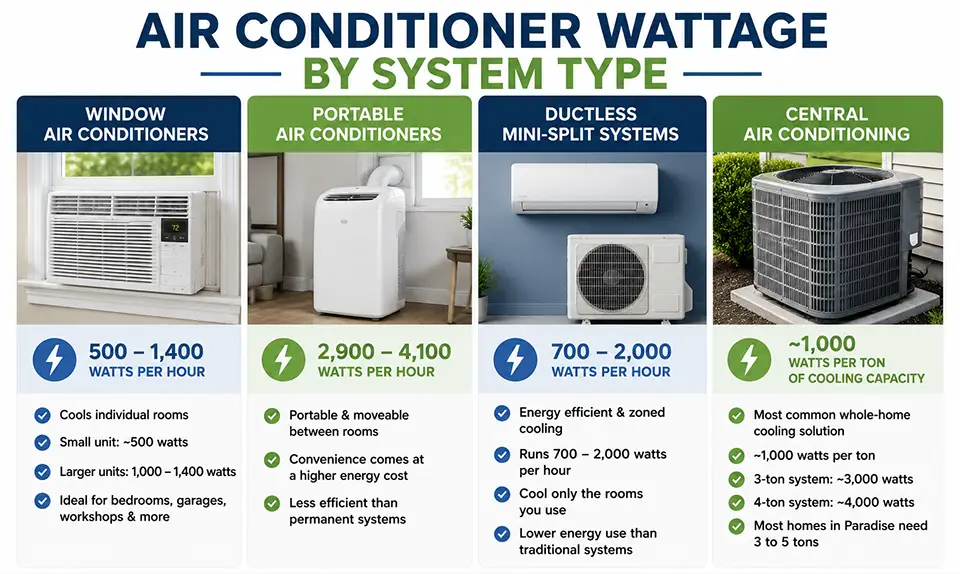
Window air conditioners cool individual rooms and rank among the cheapest options to run. A small unit uses around 500 watts an hour, while larger models built for bigger rooms climb to somewhere between 1,000 and 1,400 watts. They're a popular pick for bedrooms, garages, and workshops where running ductwork wouldn't make sense.
Portable air conditioners give you the freedom to roll them from room to room, but that convenience costs you. Most use between 2,900 and 4,100 watts an hour and don't match the efficiency of permanently installed equipment.
Ductless mini-split systems have caught on thanks to their efficiency and zoning. They typically run between 700 and 2,000 watts an hour, and since you can control each indoor unit on its own, you cool only the rooms you're actually using. That targeted approach often means lower energy use than a traditional central system.
Central air conditioning is still the go-to for homes across North Texas. Power use scales with size, running about 1,000 watts per ton of cooling capacity. A typical 3-ton system pulls roughly 3,000 watts an hour, while a 4-ton unit lands closer to 4,000. Most homes in Paradise need something in the 3- to 5-ton range to handle the summer heat.
What Affects AC Energy Consumption?
System size and cooling capacity play a major role. Cooling capacity is measured in BTUs, and bigger homes need more of it, which usually means higher power use. An undersized unit runs constantly while struggling to hit your target temperature, and an oversized one short cycles, flipping on and off in a way that wastes energy too. Proper sizing matters for both comfort and your wallet.
SEER2 efficiency ratings tell you how efficient a system is. A higher rating means the same cooling output for less electricity. Swapping an old air conditioner for a newer high-efficiency model can cut your monthly operating costs in a real way.
Outdoor temperatures push your system harder the hotter it gets. North Texas summers bring long stretches of extreme heat, and during those runs your AC works longer cycles and burns more power. Homes baking in direct sunlight all day feel it even more.
Thermostat settings hit your bill directly. Knocking the temperature down a few degrees seems harmless, but it can keep the system running considerably longer. Most experts suggest around 78 degrees when you're home, bumped up a bit when you're out.
Insulation and air leakage make a big difference. A well-sealed home keeps your cooled air where it belongs. Poor insulation, drafty windows, and gaps around doors let cool air slip out and hot air sneak in, forcing the AC to run longer. Attic insulation, weatherstripping, and air sealing often deliver noticeable savings.
Maintenance and equipment condition matter more than people realize. One summer, a homeowner mentioned their electric bill had jumped even though they hadn't touched the thermostat. The culprit turned out to be a badly clogged air filter choking off airflow through the whole system, and that kind of thing happens all the time. Dirty filters, clogged coils, refrigerant problems, and skipped maintenance all drag down efficiency. When airflow gets restricted, your AC has to work harder for the same result. Routine professional maintenance keeps energy use in check and stretches the life of your equipment.
Estimating Your Cooling Costs
You don't need a calculator to get a rough sense of your costs. Take your system's wattage, factor in how many hours it runs each day, and translate that into kilowatt-hours at your local electricity rate. As an example, a 3,000-watt central system running about eight hours a day works out to roughly 24 kilowatt-hours, which at fifteen cents per kilowatt-hour lands somewhere around $3.60 a day. Keep in mind that air conditioners cycle on and off rather than running flat out, so your real-world cost usually comes in lower than a straight estimate suggests.
Signs Your AC May Be Using Too Much Electricity
- Longer cooling cycles
- Frequent system cycling
- Uneven temperatures between rooms
- Reduced airflow
- Excess indoor humidity
- Repairs that keep cropping up
A sudden jump in your utility bill is usually the first red flag. When these issues show up, it's worth having the system inspected to find any efficiency problems hiding underneath.
Ways to Cut Your Cooling Costs
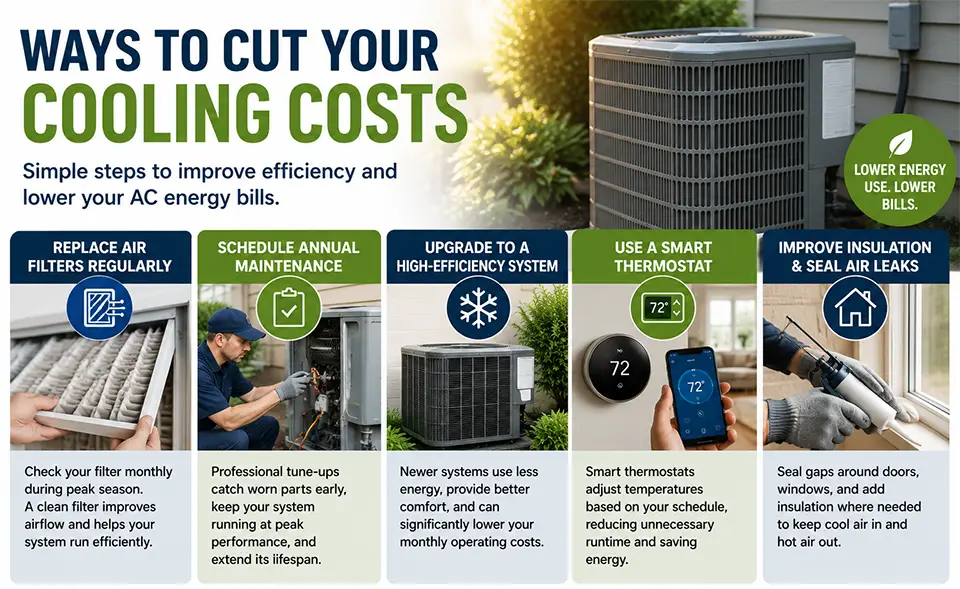
Replacing your air filters regularly keeps airflow strong and the system running efficiently, so check them monthly during peak season. Scheduling annual professional maintenance catches worn parts and keeps everything tuned up. Upgrading to a high-efficiency system can pay off if yours is a decade or more old, since newer units run circles around equipment from 10 to 15 years back. A smart thermostat trims unnecessary runtime by adjusting around your schedule, while improving insulation and sealing doors and windows keeps your cooled air from leaking away.
Final Thoughts
Even a well-maintained air conditioner loses efficiency as it ages. If yours is more than 10 to 15 years old, needs frequent repairs, or can't keep the house comfortable, replacement may be the smarter financial move. Modern systems bring higher SEER2 ratings, better humidity control, quieter operation, and lower energy use, and a lot of homeowners see their bills drop soon after upgrading.
Knowing how many watts your air conditioner uses gives you real insight into your home's energy picture. System size, efficiency rating, outdoor heat, maintenance habits, and thermostat settings all shape how much electricity your cooling equipment demands. Keep your system maintained and properly sized for your home, and you'll hold your energy costs down while staying comfortable through the worst of the heat. If you have questions about your air conditioner's performance, efficiency, or energy usage, contact us today at (682) 233-3367.