


The almighty air conditioner: perhaps the most critical component in your entire home, especially when the Texas summer kicks into high gear. Yet, despite its importance, many homeowners have limited knowledge of how it operates.
At Empire Heating & Air, we thought it would be a good idea to walk you through the inner workings of your heating and cooling system. A basic understanding of your HVAC could save you money and help avoid unnecessary service calls.
What is an HVAC System?
HVAC stands for Heating, Ventilation, and Air Conditioning. It's essentially the system responsible for controlling the climate in your home.
Whether your home uses a central heating and air system, a ductless setup, or a heat pump, all HVAC systems operate on a fundamental scientific principle known as Charles's Law.
This principle suggests that the temperature of a gas changes in direct proportion to its pressure. By adjusting the refrigerant pressure, your HVAC system can either cool or warm your home's interior.
Making It All Work
The key to your HVAC system's function is the refrigerant, which cycles continuously between the outdoor and indoor units. This process involves changing the refrigerant's pressure to harness Charles's Law effectively.
The cycle starts with the outdoor unit compressing the refrigerant, which makes it very hot. Then, the refrigerant is allowed to cool, which causes it to turn into a liquid. As it moves indoors, the refrigerant expands into a gas and begins to cool down. As it cools, it can start absorbing heat from your home's interior. The refrigerant then carries this absorbed heat back outside, maintaining a comfortable temperature inside.
Key Components of an HVAC System
Understanding the main parts of your HVAC system can help you better grasp how it keeps your home comfortable:
- Outdoor Unit (Condenser): Located outside your home, this unit contains the compressor, condenser coil, and condenser fan. The compressor moves the refrigerant throughout the system. The condenser coil releases the absorbed heat outdoors, assisted by the fan.
- Indoor Unit: Typically situated in the attic or a utility closet, this part includes the evaporator coil and blower. The coil absorbs heat from the indoor air while the blower circulates air across the coil.
- Refrigerant-Filled Tubing (Line Set): This tubing connects the outdoor and indoor units, allowing the refrigerant to transport heat in and out of your home.
While we don't expect homeowners to become HVAC specialists, basic knowledge can aid in discussing maintenance or deciding on system upgrades.
The Cooling and Heating Process
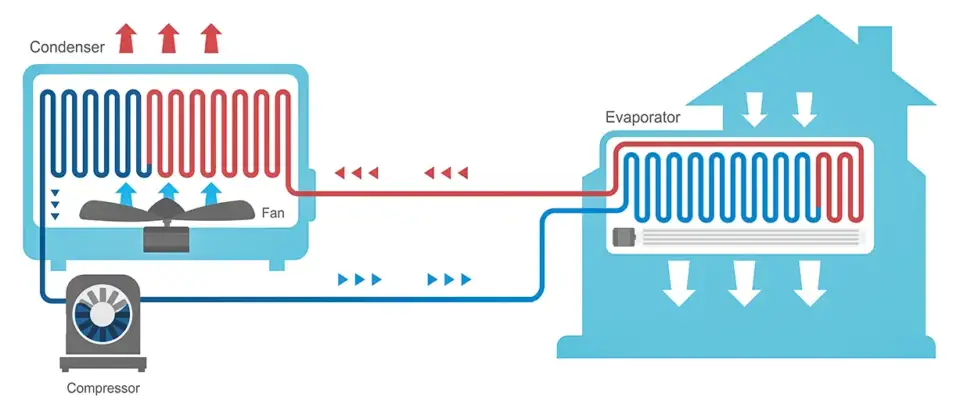
- Compression: Begins with the compressor increasing the refrigerant's temperature by raising its pressure.
- Condensation: The refrigerant then moves to the condenser coil, releasing its heat to the outside air and turning it into a liquid.
- Expansion and Evaporation: As the liquid refrigerant enters the indoor unit, it expands, cools, and turns back into a gas. This process absorbs heat from the indoor air.
- Heat Absorption and Circulation: After absorbing indoor heat, the refrigerant cycles back outside. Simultaneously, the blower distributes the now-cooled air throughout your home.
This cycle is fundamental to how your HVAC system cools your home.
Final Thoughts
Understanding how your HVAC system operates is beneficial to you, as a homeowner. It prepares you to identify potential problems, perform simple maintenance tasks, and effectively communicate with service professionals. Regular maintenance ensures your system's efficiency and longevity, ultimately preventing many common issues.
Comfort in your home is essential, and here at Empire Heating & Air, we want to assist with any questions or concerns. Contact us at (682) 233-3367 for support with your heating and cooling needs. Your comfort is our priority, and we're committed to helping you maintain an efficient and comfortable home environment.