

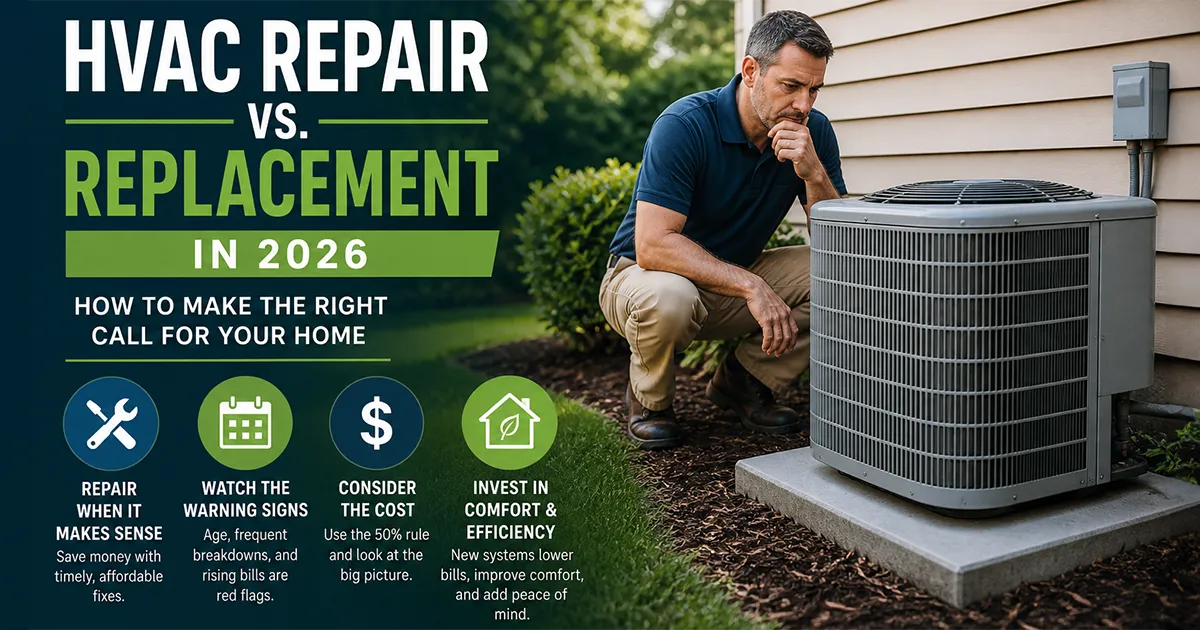
If you've ever stared at a repair estimate and wondered whether you're throwing good money after bad, you're not alone. One service call leads to another, the bills keep coming, and at some point the question stops being "what's wrong with the system" and starts being "is this system even worth fixing?"
That question carries more weight in 2026. Energy costs aren't going anywhere, efficiency standards have shifted the way homeowners compare new equipment, and a lot of systems installed in the early 2000s are quietly running out of runway. The good news is that repair vs. replacement doesn't have to be a guessing game. There are real, practical ways to think through the decision before you're forced into it.
Age Tells You a Lot
Most central air conditioners and furnaces have a realistic lifespan of 15 to 20 years, though performance tends to slide well before the system actually dies. Heat pumps often wear faster because they work year-round. If your system is pushing 10 to 15 years old and you've started noticing problems, age isn't just a number here — it's context.
An older system that's been well-maintained and needs a minor fix is a different situation than an aging unit that's been limping along for a few years. The age of the system matters most when you pair it with everything else: how often it breaks down, what the repair bills are adding up to, and how well it's actually doing its job.
Warning Signs Worth Taking Seriously
Some problems announce themselves. Grinding, banging, rattling, or squealing aren't sounds a healthy system makes. A unit that short-cycles — turning on and off constantly — or runs nonstop without reaching the set temperature is telling you something. So are rooms that never feel right: the upstairs that's always too hot, the bedroom that never catches up, the humidity that makes summer feel worse than it should.
Rising energy bills are subtler, but worth tracking. If your usage habits haven't changed much and your heating or cooling costs keep climbing, the system is probably working harder than it should to deliver the same result. That's efficiency loss, and it tends to get worse over time, not better.
Major component failures shift the conversation quickly. A failed compressor, cracked heat exchanger, bad blower motor, or failing evaporator coil on an older system can push repair costs into territory where replacement just makes more financial sense. Outdated refrigerant adds another layer — repairs on older systems using discontinued refrigerant can be more expensive and harder to justify.
The 50% Rule (and Why It's Not Perfect)
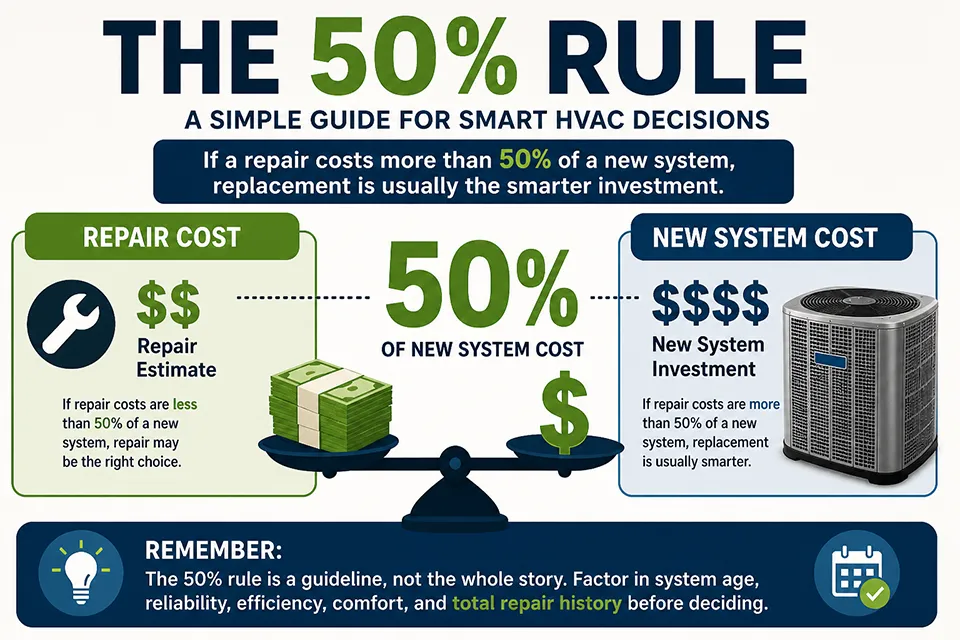
A widely-used guideline in the HVAC industry is the 50% rule: if a repair costs more than half the price of a new system, replacement is usually the smarter investment. It's a decent starting point, but it doesn't tell the whole story.
What the rule misses is the cumulative cost. A $400 repair doesn't look bad on its own. But if you spent $600 the season before and $500 the season before that, the math looks different. Add up everything you've spent on repairs over the past two to three years, not just today's estimate. That number often reframes the decision.
The stress cost is real too. Emergency replacement during a heat wave or a hard freeze is a miserable experience. You're rushed, options feel limited, and it's harder to think clearly about what you actually want. A planned replacement gives you time to compare equipment, ask questions, and budget properly — which is worth something even before you factor in energy savings.
What a New System Actually Gets You
A replacement isn't just trading old equipment for new equipment. Modern heating and cooling systems are built to a different standard than what was installed 15 years ago.
Variable-speed and two-stage systems run at lower capacity for longer periods instead of blasting on and shutting off. The result is steadier temperatures, better humidity control, and less wear on the equipment. Homes that used to have hot spots upstairs or cold corners often see real improvement, not from adjusting the thermostat, but from equipment that modulates properly.
Smart thermostats pair well with newer systems and offer remote access, better scheduling, and energy management that older equipment couldn't support. Quieter operation is another difference that catches homeowners off guard — outdoor units that once rattled the windows are replaced by equipment designed for much lower noise levels.
If indoor air quality is a concern, a new system can also be an opportunity to add better filtration, humidity control, or air purification in ways that older equipment didn't support well. For households dealing with dust, allergens, or stale air, that's not a minor detail.
When Repair Makes Sense
Repair is often the right call, and our technicians are honest about that.
If the system is under 10 years old, has been maintained reasonably well, and the issue is isolated — a faulty capacitor, a clogged drain line, a thermostat problem, a dirty coil — repair usually makes sense. These are normal wear items, not signs of system failure.
Repair also makes sense when energy bills have stayed consistent, comfort has been good overall, and the breakdown is genuinely the first real problem you've had. Fixing the system lets you get more value from equipment you already own without rushing into a bigger expense.
Regular maintenance matters here too. Changing filters on schedule, keeping the outdoor unit clear, and scheduling seasonal tune-ups reduce wear and help catch small problems before they become expensive ones.
When Replacement Is the Better Investment
Replacement earns its place when the system is old, unreliable, and increasingly expensive to keep running. Frequent service calls, uneven comfort, climbing energy bills, and a growing list of complaints are collectively telling you something.
Spending heavily on repairs for aging equipment can feel like a solution, but it often just delays the next failure. A new compressor on a 16-year-old system may keep things running for another season, but it doesn't address everything else that's wearing out at the same rate.
Homeowners planning to stay in their home tend to benefit most. They get more time to enjoy reliable performance, better comfort, quieter operation, and whatever energy savings the new equipment delivers. Families who work from home, have young children, or care for older relatives often place real value on a system that just works consistently.
Sellers sometimes benefit from replacement too, particularly when the old system would have raised flags during inspection. It's not the right move in every situation, but a new HVAC system can give buyers confidence that a dated or unreliable system would undermine.
Budgeting for Replacement
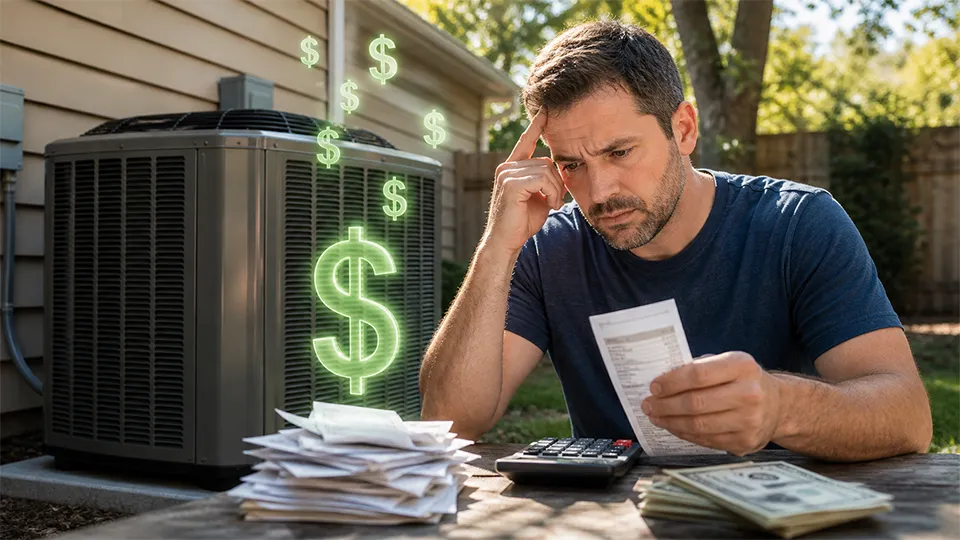
Replacement cost varies based on home size, system type, efficiency level, ductwork condition, installation complexity, and any optional upgrades. The lowest upfront price isn't always the best value. Proper sizing, quality installation, and equipment that actually fits your home matter more than shaving a few hundred dollars off the estimate.
Oversized equipment short-cycles, wastes energy, and struggles with humidity. Undersized equipment runs constantly and still leaves rooms uncomfortable. We size equipment based on a real assessment of your home (square footage, insulation, windows, duct condition, and layout) is doing the job right.
Ductwork often gets overlooked in the budgeting conversation. Leaky or poorly connected ducts can undermine a new system the same way they hurt the old one. If airflow was already a problem, that should be evaluated alongside the equipment.
Before you need to make a decision, start looking at financing options, available rebates, utility incentives, and any applicable federal tax credits. Timing your replacement before the system fails gives you breathing room to do this properly.
Final Thoughts
A minor issue on a well-maintained younger system usually deserves a repair. A system that's old, repeatedly breaking down, driving up energy bills, and struggling to keep the home comfortable is likely costing you more than you realize — and replacement is probably the smarter long-term call.
You don't have to figure this out alone. A thorough inspection from one of our qualified HVAC technicians can tell you whether the problem is isolated or part of a bigger pattern of decline. The technician will give you honest answers about both options and help you understand what makes sense for your home, your budget, and how long you plan to stay.
If you're weighing a repair bill against a replacement quote, or you just want to know where your system actually stands, contact us today at (682) 233-3367 to schedule an inspection or consultation. A little clarity now can save a lot of stress later.